

In marine engineering, a common misconception persists: that raw horsepower and total thrust are the sole metrics determining a vessel’s top speed. On the surface, the logic seems linear—increase the kilowatts within the hull, and the vessel will achieve higher velocities.
However, fluid dynamics presents a fundamental paradox that challenges this assumption.
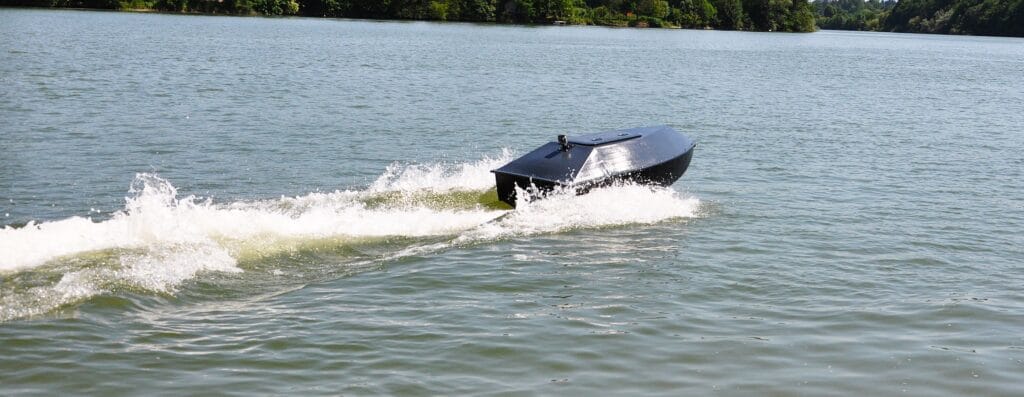
Consider a massive container vessel outputting over 50,000 horsepower, yet fundamentally limited to a top speed of roughly 20 knots (37 km/h). Conversely, a standard personal watercraft (PWC) or an unmanned surface vehicle (USV) utilizing a mere 100 horsepower can easily exceed 50 knots (93 km/h).
The explanation lies in a core hydrodynamic principle: Thrust volume alone does not determine high-speed capacity; the ultimate limiting factor is the exit velocity of the water jet.
Fluid Mechanics: Mass Flow Rate vs. Jet Velocity
Every marine propulsion system—whether an open propeller or an axial-flow waterjet—operates strictly under Newton’s Third Law of Motion. To generate forward propulsive force (thrust), an equivalent mass of water must be accelerated rearward.
The total thrust (T) generated by a propulsion system can be mathematically defined by the mass flow rate (m) and the change in fluid velocity (v):
This equation dictates that a specific thrust target can be achieved through two completely different engineering approaches:
Accelerating an immense mass of water (m) to a low exit velocity (Vexit).
Accelerating a smaller mass of water (m) to an extremely high exit velocity (Vexit).
Herein lies the critical hydrodynamic constraint: A vessel cannot physically travel faster than the net velocity of the fluid leaving its propulsion system. As the vessel’s forward speed approaches the exit velocity of the discharged water, net thrust drops toward zero.
Comparative Analysis: Displacement Giants vs. Hydrodynamic Jets


To visualize this operational threshold, we look at the two opposite spectrums of marine propulsion design.
1. Large Commercial Displacement Vessels
Power Output: 50,000+ hp
Propulsion Architecture: A massive, slow-turning, open propeller (often exceeding 9 meters in diameter).
Hydrodynamic Action: This system prioritizes mass flow rate. It displaces millions of liters of water per second at low RPM. The system yields exceptional static thrust, necessary to overcome the massive hydrodynamic drag of a 200,000-ton displacement hull. However, because the exit velocity of the water stream is low, the propulsion system reaches its kinetic ceiling at a very low speed. Additional energy inputs past this point result only in cavitation and severe efficiency losses, not speed.
2. Jet-Propelled Vessels & High-Speed USVs
Power Output: 100 – 300 hp
Propulsion Architecture: An enclosed axial or mixed-flow pump utilizing a tight-tolerance impeller and a restrictive reduction nozzle.
Hydrodynamic Action: Instead of moving a large volume of the water column, a waterjet confines a smaller mass flow rate within an internal duct. The internal impeller pressurizes the fluid, which is then forced through a progressively narrowing exit nozzle. By compressing the volume, the discharge exit velocity is increased exponentially. Because the fluid exits the nozzle at such extreme speeds, the vessel retains positive net thrust at much higher velocities.
The Velocity Rule: High-speed performance requires high-speed discharge. Once a vessel’s velocity matches the fluid’s exit velocity, acceleration ceases. Open propellers excel at moving weight; waterjets excel at moving fast.
The Internal Mechanics of Waterjet Efficiency

The superior efficiency of waterjets at high speeds is a direct result of their closed-loop internal architecture, which systematically eliminates the primary losses associated with open propellers:
The Impeller Assembly: Unlike an open propeller, an impeller operates within a precisely machined wear ring. This shroud completely eliminates tip vortex losses—where high-pressure fluid escapes over the blade tips—maximizing energy transfer into fluid pressure.
The Stator Vanes: As fluid leaves the rotating impeller, it possesses high rotational (radial) energy. A series of fixed stator vanes immediately redirect this turbulent flow, straightening the fluid vectors. This converts waste rotational kinetic energy into purely linear, forward thrust.
The Reduction Nozzle: Acting as the final stage, the restriction nozzle leverages the Venturi effect. As the cross-sectional area of the nozzle decreases, the fluid velocity must increase proportionally to maintain continuity. This is where the pressurized energy built by the impeller is converted directly into pure exit velocity.
Engineering Implications for High-Speed USV Architecture
For engineers, naval architects, and developers of autonomous surface vehicles (USVs), balancing nozzle dynamics is a critical phase of propulsion design:
Nozzle Optimization: If the exit nozzle diameter is too wide, exit velocity drops, restricting the vessel’s top speed despite having excess engine power. Conversely, choking the nozzle too narrow creates extreme internal backpressure, inducing severe pump cavitation, structural loads, and an immediate drop in overall efficiency.
Structural Integrity of Materials: At high fluid velocities, the structural rigidity of internal pump components is paramount. This is precisely why Standard polymers fail under the intense hydrodynamic pressures generated within a high-velocity stator or impeller assembly. Deflection or micro-flexing of the blades alters the internal geometry of the pump, causing instant losses in fluid compression and severely degrading the exit velocity.

Conclusion: When engineering for high-speed marine applications, horsepower is merely a prerequisite. The true engineering objective is the optimization of internal fluid dynamics to achieve the maximum possible exit velocity. Managing fluid acceleration, rather than brute force, is what fundamentally separates high-speed jet propulsion from traditional open-propeller systems.