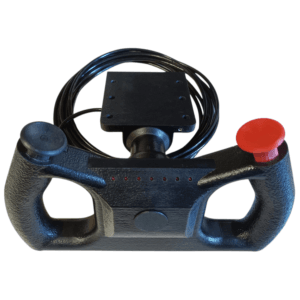
USV Power Control Unit – PCU S1

Product Overview
The Power Control Unit S1 (PCU S1) is an all-in-one plug-and-play interface module designed specifically for the JetX-100V4 propulsion system. Furthermore, this unit bridges the gap between the propulsion hardware (ESC, main BLDC motor, and steering servo) and your preferred control device—such as a standard RC receiver, flight controller, or autopilot system.
By streamlining signal routing and power delivery into a single compact housing, the PCU S1 gives you complete control over throttle response and vectoring steering. Consequently, you can build a clean and reliable setup without dealing with complex, custom wiring harnesses.
Why Choose the PCU S1?
Eliminate Wiring Complexity: Instead of splicing multiple signal wires and adding separate voltage regulators, this single module handles all power distribution and signal routing.
Protect Sensitive Receiver Gear: Heavy steering loads can cause voltage sags on standard receiver buses. However, the integrated power supply isolates and protects your autopilot or receiver.
Instant Deployment: Because the system features smart auto-calibration, you can swap transmitters or flight controllers without manual software tuning.
Key Features
- High-Current Servo Power Stabilization:
Standard RC receivers and flight controllers often struggle to provide sufficient or stable current to high-torque steering servos under heavy hydrodynamic loads. The PCU features an integrated step-down converter that delivers a stabilized, high-current 12 V power supply directly to the steering servo, preventing power sags and signal dropouts. - Auxiliary Power Supply (12 V OUT):
The module provides a regulated 12 V DC output (up to 5 A) to directly power compatible RC receivers, telemetry units, or flight controllers, eliminating the need for an external BEC or secondary battery.

Smart Throttle Auto-Calibration (PCU Auto-Calibration)
The PCU (Power Control Unit) is equipped with an advanced automatic throttle signal detection and calibration algorithm. Every time the system boots up, it automatically analyzes the input signal from your control device (remote controller or autopilot) and adapts to the position and baseline of your throttle stick.
How Automatic Calibration Works
Throttle Range Detection:
- Center Zero Position: If you are using a spring-loaded joystick or transmitter with a neutral center position (standard signal around 1500 µs), the PCU recognizes this at boot and sets the center point as 0 % throttle, using the upward travel for acceleration.
- Bottom Zero Position: If you are using a traditional throttle stick with the zero point at the very bottom (signal around 1000 µs), the PCU sets this lowest point as 0 % throttle, mapping the entire upward stroke to full power output.
Technical Specifications
| Feature | Specification |
| Input Signal Compatibility | Standard PWM (RC Receivers, Flight Controllers, Autopilots) |
| Servo Output Power | Regulated 12 V DC (High-Current Peak Output) |
| Auxiliary Output Power | Regulated 12 V DC (Up to 5 A Continuous) |
| Calibration Mode | Fully Automatic Boot-Time Signal Detection |
| Enclosure & Connectors | Compact Marine-Grade Housing / Plug-and-Play Marine Connectors |
INSTRUCTION MANUAL: CLICK HERE
Frequently Asked Questions (FAQ)
Do I need a computer or software to set up the PCU S1?
No, not at all. Because the onboard processor features fully automatic calibration, the unit configures itself on every startup. Therefore, you can plug in your receiver and begin operating immediately without software installation.
Can I power my flight controller directly from the PCU S1?
Yes, absolutely! The 12 V DC auxiliary output supplies up to 5 A of continuous power. Specifically, this output is more than sufficient to power standard flight controllers, telemetry transmitters, and RC receivers safely.
What happens if I change my RC transmitter model?
You do not need to perform any manual re-calibration. Because the PCU S1 automatically analyzes stick positions at boot, it detects the signal ranges of your new transmitter instantly.